‘Satin evening gown’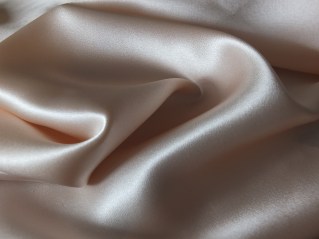
‘Satin bridal robe’
‘Satin slip’
‘Satin lounging pants’
‘Satin sheets’
When you read the above, or when a friend says she bought a ‘satin evening gown’, do you automatically think it is made of silk?
You are not alone. Buyers make the mistake of presuming that satin = silk. Unfortunately some traders take advantage of this and ‘pass off’ other fabrics (for example, satin made of polyester) as silk satin.
Satin can be made of silk, nylon, polyester, acetate, rayon etc. The ‘satin’, to be accurate, should then be referred to as, a ‘silk satin’ or a ‘polyester satin’ or an ‘acetate satin’ and so on.
Satin is the method of creating the fabric, (the weave), which results in a glossy surface on one side of the fabric, with a dull back. It is not what it is made of.
When cotton is used, the fabric is usually referred to as cotton sateen.
A basic fabric is woven with the warp and weft threads going one over, and one under. The weave for satin, is four over and one under with fewer inter-lacings of the threads, hence the glossy finish.
Originally satin came from China, in the 12th century, and was only made of silk. The port city from where it was shipped, ‘Zayton’ gave satin its name. Silk satin was an exotic item traded between China, the Arab World and Western Europe during the Middle Ages. It was available in Italy during the 12th century and by the 14th century, silk satin was available throughout Europe. Due to the price though, it was enjoyed and worn, mainly by royalty and the ‘upper classes’.
‘Charmeuse’, …… a cousin of satin, also has a glossy sheen, but it is more muted, and is usually a lighter, softer fabric.
Modern day uses of satin are evening gowns, wedding gowns, formal clothing, lingerie, upholstery and bedding.
When buying satin…..know what you are paying for. Don’t get caught paying for silk satin when the satin is made from polyester or acetate.
Hope this clears up some confusion…
 Lunar Silk